Champagne vs Sparkling Wine: What's Worth Paying For (and What to Buy for Brunch)
You're standing in front of a wall of sparkling wines, staring at price tags that range from $12 to $120, asking yourself the same question everyone does: Is Champagne actually worth it?
Sometimes yes. Sometimes absolutely not. And knowing the difference will save you money while making sure you're actually enjoying what's in your glass.
At The Pip, we walk people through this exact question all the time. Most folks don't need a lecture on terroir—they need to know what to grab for brunch, what to pop on date night, and when it actually makes sense to spend more.
The Only Difference That Legally Matters
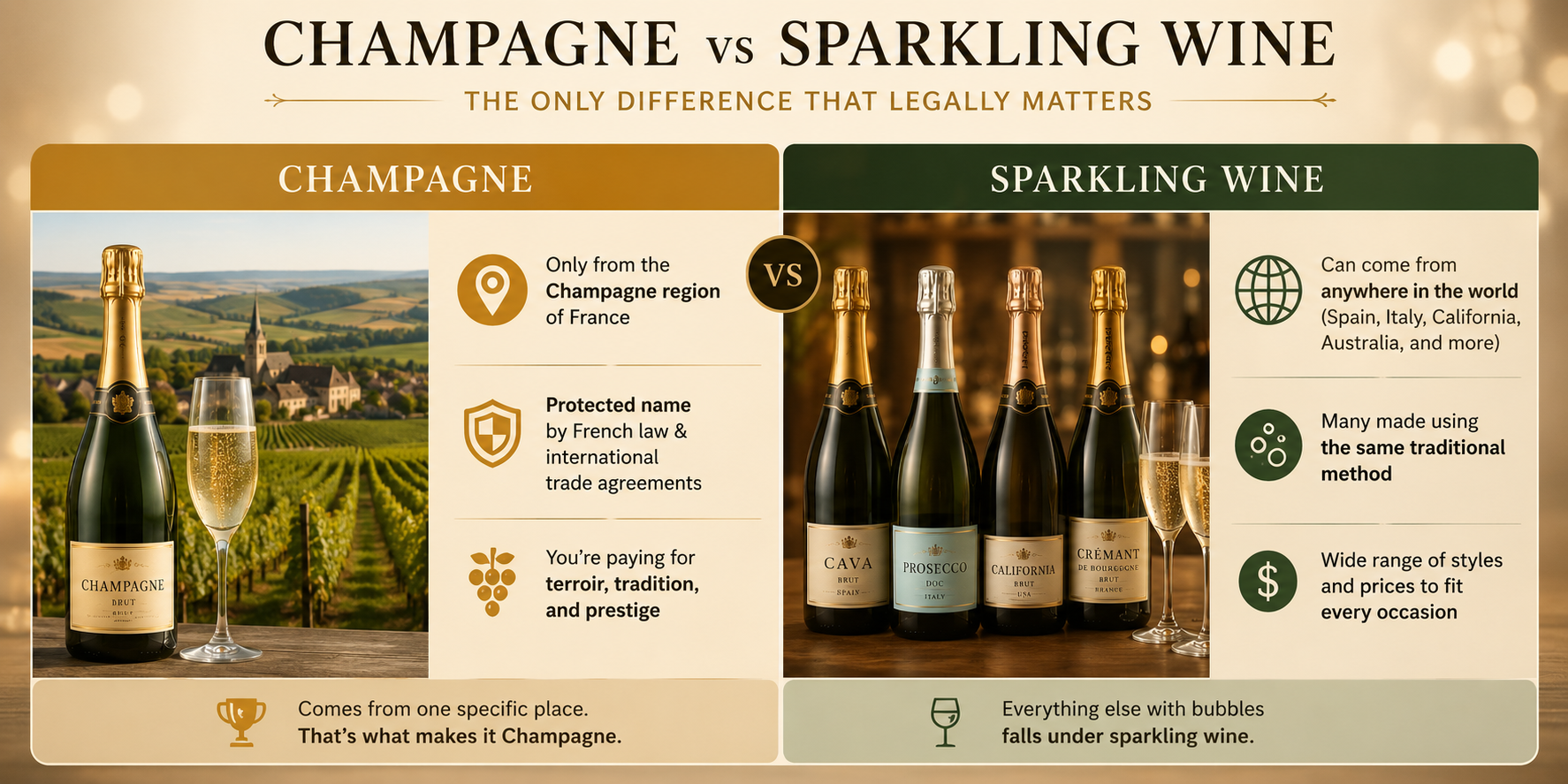
Champagne is sparkling wine. But sparkling wine isn't Champagne.
Champagne can only come from the Champagne region of France. That's the rule. If those bubbles came from anywhere else—California, Spain, Italy, Australia—it cannot legally be called Champagne in most of the world.
The name is protected by French law and international trade agreements. When you pay for a bottle of Champagne, part of what you're paying for is geography. The chalky soils of that specific region. The climate. The history. And yes, the prestige.
Everything else with bubbles falls under the sparkling wine umbrella.
What Actually Makes Champagne Expensive
There's real substance behind those higher price tags—not just marketing.
The traditional method. Real Champagne undergoes a labor-intensive process called méthode traditionnelle. The wine goes through a second fermentation inside the actual bottle you buy. That creates the bubbles. Then the bottles are riddled—rotated by hand or machine—and aged on the yeast (called lees) for at least 15 months for non-vintage and three years for vintage.
This process takes time, labor, and skill.
Limited land. The Champagne region is small. Demand is global. Supply stays relatively fixed. That scarcity drives prices up.
Brand investment. Major Champagne houses spend significantly on marketing, packaging, and positioning. Some of that cost gets passed along to you.
So when you buy Champagne, you're paying for:
Specific terroir (the soil, climate, and growing conditions)
A traditional, time-intensive production method
Mandatory aging requirements
Limited supply from a defined geographic area
Brand prestige
Whether that's worth it depends entirely on the occasion and what you actually want from the bottle.
The Sparkling Wines That Punch Above Their Price
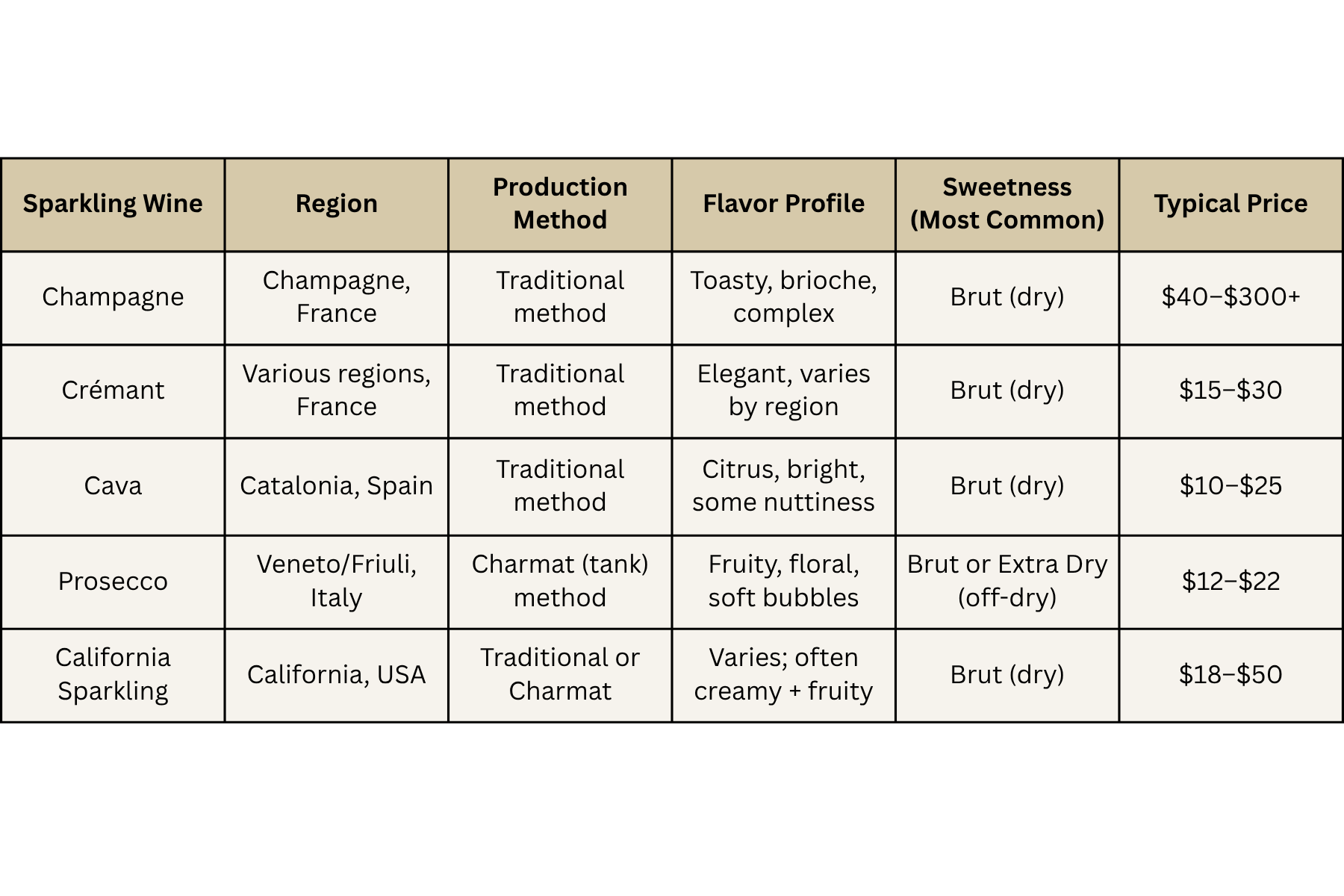
The traditional method isn't exclusive to Champagne. Other regions use the exact same process—and charge a fraction of the price.
Crémant: France's Best-Kept Secret
Crémant is French sparkling wine made outside Champagne using the same traditional method. You'll find Crémant de Loire, Crémant de Bourgogne, Crémant d'Alsace, and others.
What you get: Fine bubbles, similar toasty and brioche notes, elegant structure.
What you pay: Often $15–$25 instead of $45–$80+.
If you love the Champagne style but not the Champagne price, Crémant is your move. We keep several on our shelves for exactly this reason—producers like Lucien Albrecht and Domaine Pfister consistently deliver bottles that make people do a double-take at the price.
Cava: Spain's Traditional Method Sparkling
Cava comes primarily from the Penedès region in Catalonia, Spain. It's also made using the traditional method, with required aging minimums.
What you get: Bright, citrusy, refreshing. Some aged Cavas (Gran Reserva) develop nutty, complex flavors.
What you pay: Many excellent bottles run $10–$20.
Cava is the workhorse of brunch sparkling. It holds up to mimosas and bellinis, but the better bottles stand beautifully on their own. Segura Viudas and Gramona are two producers we reach for regularly—solid quality without the splurge.
Prosecco: The Crowd-Pleaser
Prosecco comes from the Veneto and Friuli Venezia Giulia regions of Italy. Unlike Champagne, Cava, and Crémant, Prosecco uses the Charmat method (or tank method), where the second fermentation happens in large steel tanks rather than individual bottles.
What you get: Lighter, fruitier, with softer bubbles. Think green apple, pear, and flowers.
What you pay: Typically $12–$20 for solid quality.
Prosecco is approachable and easy-drinking. It's the "let's open something fun" sparkling—perfect when you want bubbles without overthinking it. La Marca is everywhere for a reason, but if you want to step up slightly, look for Prosecco Superiore DOCG from the Conegliano-Valdobbiadene hills.
California Sparkling: Don't Sleep on Domestic
Since we're a California wine bar, we'd be doing you a disservice not to mention what's happening in our own backyard.
California produces excellent sparkling wine, much of it using the traditional method. Regions like Anderson Valley, Sonoma, and parts of the Central Coast have the cool climate that sparkling grapes love. Several producers—some with roots tracing back to famous Champagne houses—make bottles that rival their French counterparts.
What you get: Varies widely, but the best California sparklings offer that creamy, toasty complexity with bright California fruit.
What you pay: $18–$40 for quality bottles, with some prestige cuvées climbing higher.
Roederer Estate (Anderson Valley) is the gold standard for California traditional method sparkling—founded by the same family behind Louis Roederer Champagne. Schramsberg and Gloria Ferrer are also worth seeking out. Ask us what California sparklings we're currently carrying; it's a category worth knowing.
A Quick Comparison: What You're Actually Buying
Understanding Sweetness Levels (This Trips Everyone Up)
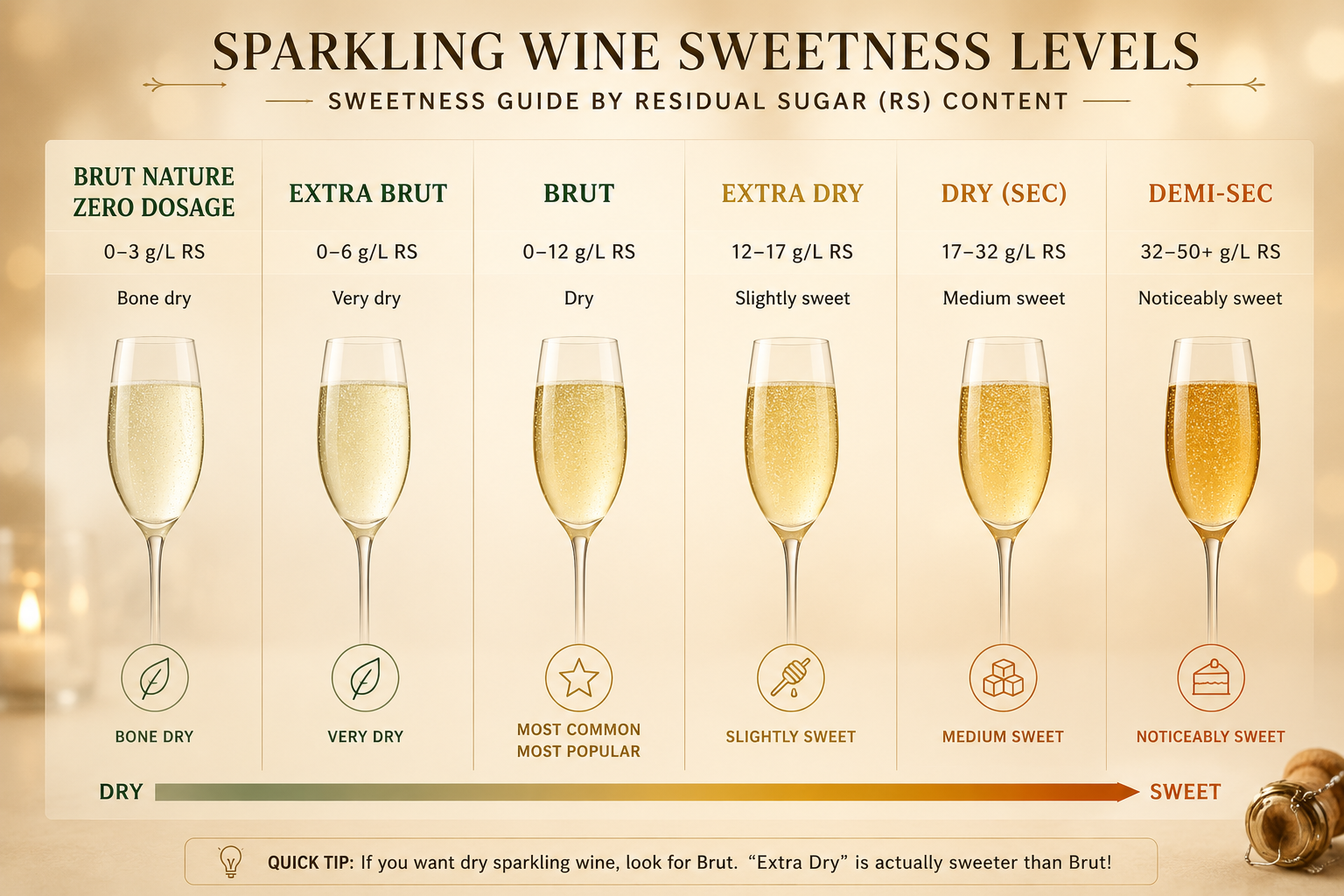
Before you grab a bottle, you need to understand sweetness labels—because they're counterintuitive.
Sparkling wine sweetness is measured by residual sugar, and the terms don't mean what you'd expect:
Brut Nature / Zero Dosage: Bone dry. No added sugar.
Extra Brut: Very dry.
Brut: Dry. This is the most common style and what most people want.
Extra Dry: Slightly sweet. Yes, "Extra Dry" is actually sweeter than Brut.
Dry (Sec): Medium sweet.
Demi-Sec: Noticeably sweet. Good for dessert pairings.
If you want dry sparkling wine, look for Brut. The "Extra Dry" label fools people constantly—it sounds drier, but it's not.
When Champagne Is Actually Worth It
Not every occasion calls for the Champagne price tag. But some do.
Pop the real stuff when:
You're celebrating a major milestone (engagement, promotion, big birthday)
You want the experience—the ritual, the prestige, the weight of the moment
You're pairing with rich foods like lobster, oysters, or caviar
You've had enough sparkling wine to appreciate the difference
Champagne's complexity, structure, and age-worthiness shine when you're paying attention. If you're going to sip slowly and savor, it can be worth the investment.
Save your money when:
You're making mimosas or cocktails (the orange juice doesn't care)
You're serving a crowd at brunch
You want something casual and refreshing
You're not sure if your guests will notice the difference
No shame in the practical game.
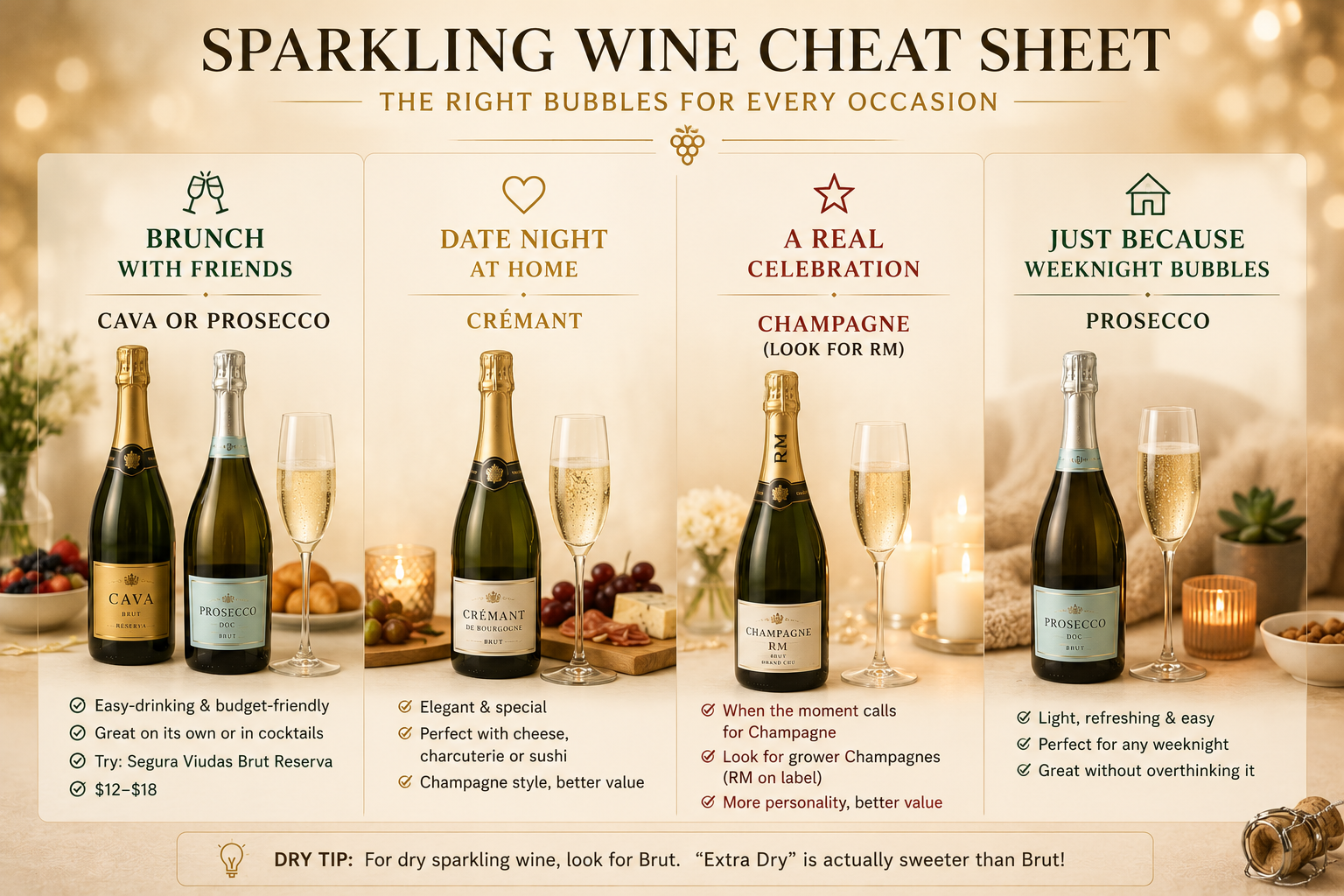
What to Buy: Your Sparkling Wine Cheat Sheet
For Brunch With Friends
Grab a Cava or Prosecco. You want something easy-drinking, budget-friendly when buying multiple bottles, and delicious whether you're drinking it straight or mixing it.
A dry (Brut) Prosecco or a young Cava Brut hits the spot. We usually point people toward Segura Viudas Brut Reserva or a comparable Spanish Cava in the $12–$18 range for this—good quality, great value, and they disappear fast at a brunch table.
For Date Night at Home
This is Crémant territory. You get the elegance and fine bubbles of Champagne without the sticker shock. Crémant de Bourgogne often has that creamy, toasty quality that feels special.
Pair it with cheese, charcuterie, or takeout sushi. It reads as thoughtful without requiring a special occasion.
For a Real Celebration
If the moment calls for Champagne, get Champagne. But skip the big-name prestige cuvées and look for smaller grower Champagnes—you'll see "RM" on the label, meaning the producer grows their own grapes. They often offer more personality and better value than mass-produced big-house bottles.
We carry a few grower Champagnes specifically because they outperform their price point. Come in and we'll walk you through them.
For "Just Because" Weeknight Bubbles
Prosecco. It's light, refreshing, and perfect for a Tuesday evening when you want something nice but don't want to think too hard about it.
The Real Secret: Drink What You Actually Like
Wine experts can debate terroir and dosage all day. But if you prefer the fruity pop of Prosecco over the toasty depth of Champagne, that's not wrong. That's your palate.
The goal isn't to spend the most money or impress anyone. It's to find what tastes good to you in that moment.
Not sure what you like yet? Try one of each. Side-by-side comparisons are the fastest way to figure out your preferences—and they make for a solid tasting party.
If you're ever unsure, just ask. We won't make you feel dumb for not knowing. We'll help you find exactly what fits your taste and your budget.
Ready to explore? Come hang out at The Pip Wine Bar & Shop in Downtown Dixon. We've got a curated selection of sparkling wines—from approachable Prosecco to grower Champagnes you won't find at the grocery store. Not sure where to start? Tell us what you're looking for, and we'll point you in the right direction.
Frequently Asked Questions
Is Champagne really better than other sparkling wines?
Champagne offers a distinct style—complex, toasty, and structured—thanks to its terroir and traditional production method. But "better" is subjective. Cava, Crémant, Prosecco, and California sparkling each bring something different to the table. Some people genuinely prefer Prosecco's fruity freshness or Cava's citrus-driven brightness. The best approach is to try several and decide what "better" means for your own palate and the occasion you're shopping for.
Can I use Champagne for mimosas?
You can, but you probably shouldn't. The subtleties of good Champagne—those toasty, yeasty notes you're paying for—get completely buried under orange juice. A dry Cava or Brut Prosecco works perfectly for mimosas and costs a fraction of the price. Save the Champagne for sipping on its own when you can actually taste what makes it special.
What's the best sparkling wine for beginners?
Prosecco is a great starting point. It's approachable, affordable, and fruity without being too sweet (as long as you choose Brut). The softer bubbles and fresh fruit flavors make it easy to enjoy. From there, explore Cava for something more structured and citrus-forward, or Crémant if you want to move toward the Champagne style without the price tag.
What does "Extra Dry" mean on a sparkling wine label?
Here's where the labels get confusing: "Extra Dry" is actually slightly sweet—sweeter than Brut. If you want dry sparkling wine, look for "Brut" on the label. This trips up almost everyone, so if you've grabbed the wrong bottle before, you're in good company. When in doubt, Brut is the safe bet for dry.
How should I store sparkling wine?
Keep bottles on their side in a cool, dark place—ideally between 45–55°F. Avoid temperature swings, which can affect the cork and the wine's freshness. Most non-vintage sparkling wines are meant to be enjoyed within a year or two of purchase, so don't hold onto them too long unless the producer specifically recommends aging. Once you're ready to serve, chill the bottle for about three hours in the fridge or 30 minutes in an ice bath.
About This Guide
This guide was created by The Pip Wine Bar & Shop, a woman-owned wine bar and bottle shop in Downtown Dixon, California. We specialize in helping people discover wines they'll actually love—without the pretense. Whether you're grabbing something for brunch or celebrating a milestone, our team is here to guide you toward bottles that fit your taste and your occasion. Come hang out with us and find your next favorite pour.