How to Start Tasting Wine at Home: A Five-Pour Practice Plan
You've got a bottle open, a glass in hand, and genuine curiosity. That's everything you need.
At The Pip, we get asked all the time: "How do I actually learn to taste wine without feeling like I'm faking it?" The answer is simpler than most people expect. You don't need expensive glassware, a cellar full of rare bottles, or years of sommelier training. What you need is a straightforward framework, a willingness to pay attention, and about five pours spread across a relaxed evening.
This plan walks you through exactly that—a practical home tasting sequence you can run in your own kitchen. No pretension. No memorizing French regions. Just a clear approach to understanding what you're drinking and, more importantly, discovering what you actually like.
Why Home Tasting Works Better Than You Think
Tasting wine at home removes the pressure that comes with restaurant settings or crowded tasting rooms. You control the pace. You can linger on a pour that intrigues you or move quickly past one that doesn't. There's no sommelier watching, no bill climbing, no feeling like you need to perform knowledge you don't have yet.
Developing your palate happens through repeated, deliberate practice—not through one-off experiences. Your living room is actually ideal for this kind of learning.
Home tasting also lets you build direct comparisons. When you taste two wines side by side, differences become obvious in ways they never do when you're drinking one bottle on Tuesday and another the following weekend.
What You Need Before You Start
Keep your setup simple. Overthinking equipment is the fastest way to kill momentum before you've even poured.
The basics:
Five bottles of wine (we'll cover selection below)
Clear wine glasses—any shape works, though a standard tulip shape helps concentrate aromas
A white surface (paper, napkin, or tablecloth) for looking at color
Water for rinsing your palate between pours
Plain crackers or bread as a neutral palate cleanser
A notebook or your phone's notes app
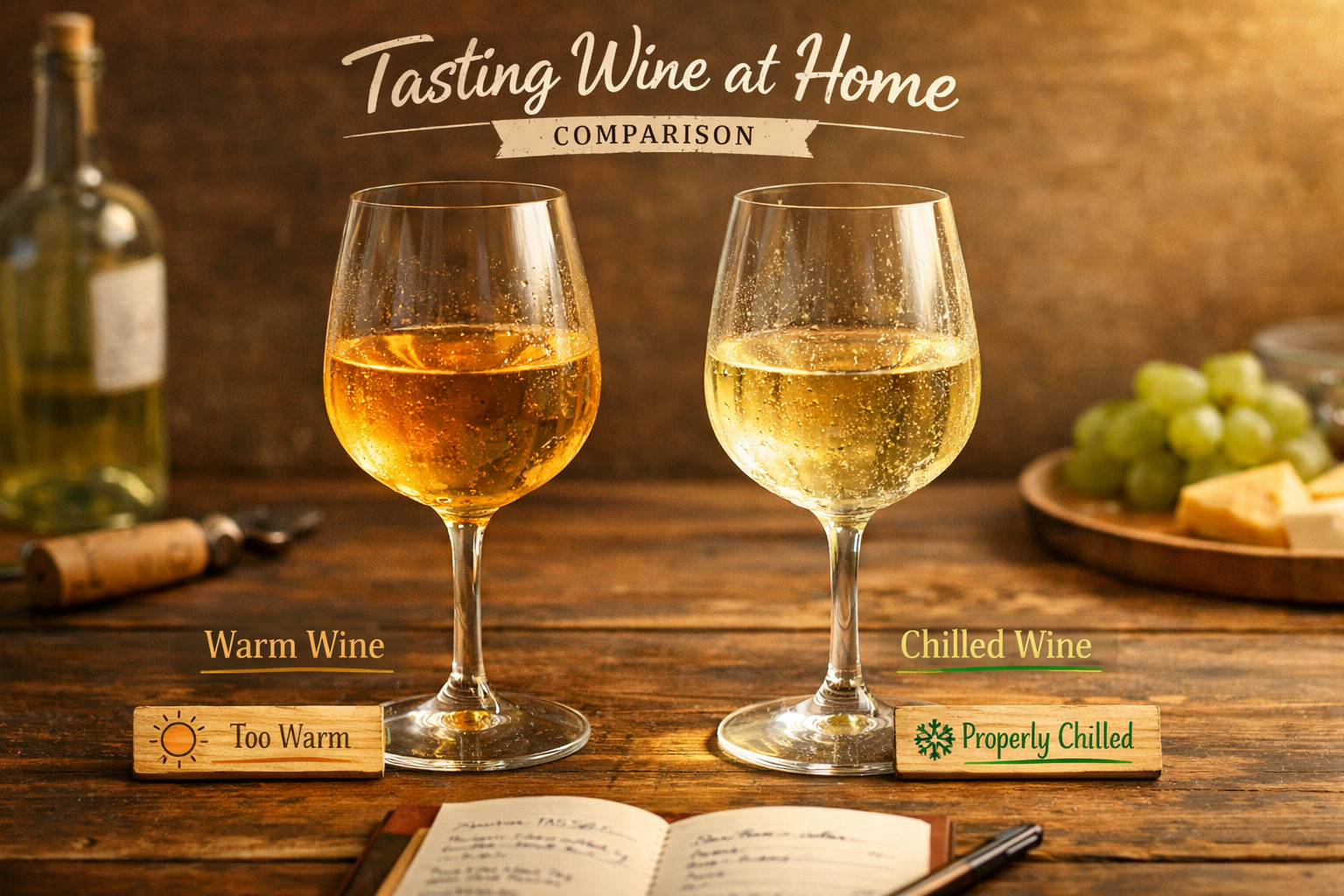
That's it. You don't need a decanter, special lighting, or a temperature-controlled environment. Room temperature for reds, slightly chilled for whites. Good enough.
The Five-Pour Practice Sequence
This sequence teaches you something specific with each pour. You're not just drinking five wines—you're building comparison points that train your palate.
Pour One: Your Baseline White
Start with a crisp, unoaked white wine. Sauvignon Blanc works perfectly here. This becomes your reference point for acidity (that refreshing, mouth-watering quality) and for fruit-forward aromas without the influence of oak aging.
What to notice:
How does it smell? Look for citrus, green apple, grass, or herbs.
How does it feel in your mouth? Light or heavy? Does it make your mouth water?
How long does the flavor last after you swallow?
Food thought: This style pairs beautifully with fresh oysters, goat cheese, or a simple green salad.
Write down three words. That's all. Don't overthink it.
Pour Two: The Contrast White
Now pour an oaked Chardonnay. This is your first deliberate comparison. Same grape category (white), completely different experience.
What to notice:
The color is likely deeper, more golden.
The aromas shift toward vanilla, butter, toast, or tropical fruit.
The texture feels richer, almost creamy.
That richness comes from oak aging and a process called malolactic fermentation—basically, sharper acids get converted into softer, rounder ones. You don't need to remember the chemistry. Just notice how different it feels from your first pour.
Food thought: Rich, creamy pasta. Lobster with butter. Roasted chicken with herbs.
Comparison prompt: Which one would you rather drink with that creamy pasta? Which with those fresh oysters? Your instinct is probably right.
Pour Three: Your Baseline Red
Move to a lighter red. Pinot Noir is ideal because it shows fruit clearly without heavy tannins getting in the way.
What to notice:
Red fruit aromas: cherry, strawberry, cranberry
Lighter body—it doesn't coat your mouth
Softer finish with minimal grip
Food thought: Salmon, mushroom dishes, duck, or honestly just by itself on the couch.
This is your red wine baseline. Everything you taste afterward gets compared to this.
Pour Four: The Contrast Red
Pour a fuller-bodied red—Cabernet Sauvignon or Malbec. Here's where you learn what tannins actually feel like.
What to notice:
Darker fruit: blackberry, plum, cassis
That drying sensation on your gums and tongue (that's tannin—like strong black tea)
More weight, more grip, longer finish
Food thought: Grilled steak, aged cheese, anything with fat and protein to balance those tannins.
Comparison prompt: Could you drink the Pinot Noir by itself, without food? What about this one? Many people find bigger reds want something to chew on.
Pour Five: The Wildcard
Your fifth pour should be something outside the first four categories. Options include:
A sparkling wine (notice how bubbles change texture and refresh your palate)
A rosé (watch how it sits between white and red characteristics)
A dessert wine (experience how sweetness changes everything)
Something unusual from a grape you've never tried
Food thought: Sparkling loves salty snacks and fried foods. Rosé works with charcuterie. Dessert wine pairs with fruit tarts or blue cheese.
This pour teaches you that wine is bigger than the four bottles you just finished. It keeps curiosity alive.
A Simple Note-Taking Pattern
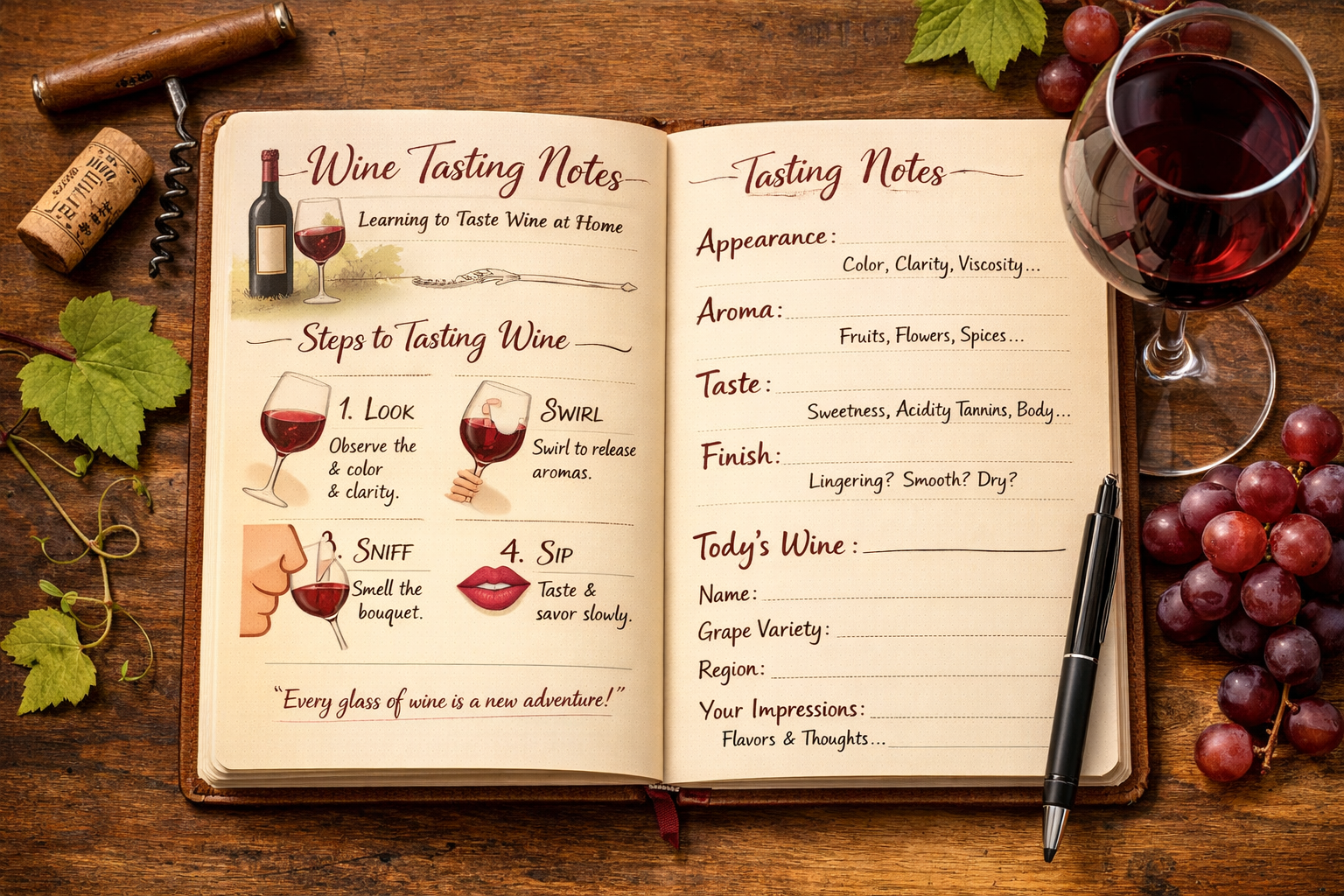
You don't need to write essays. Use this framework for each pour:
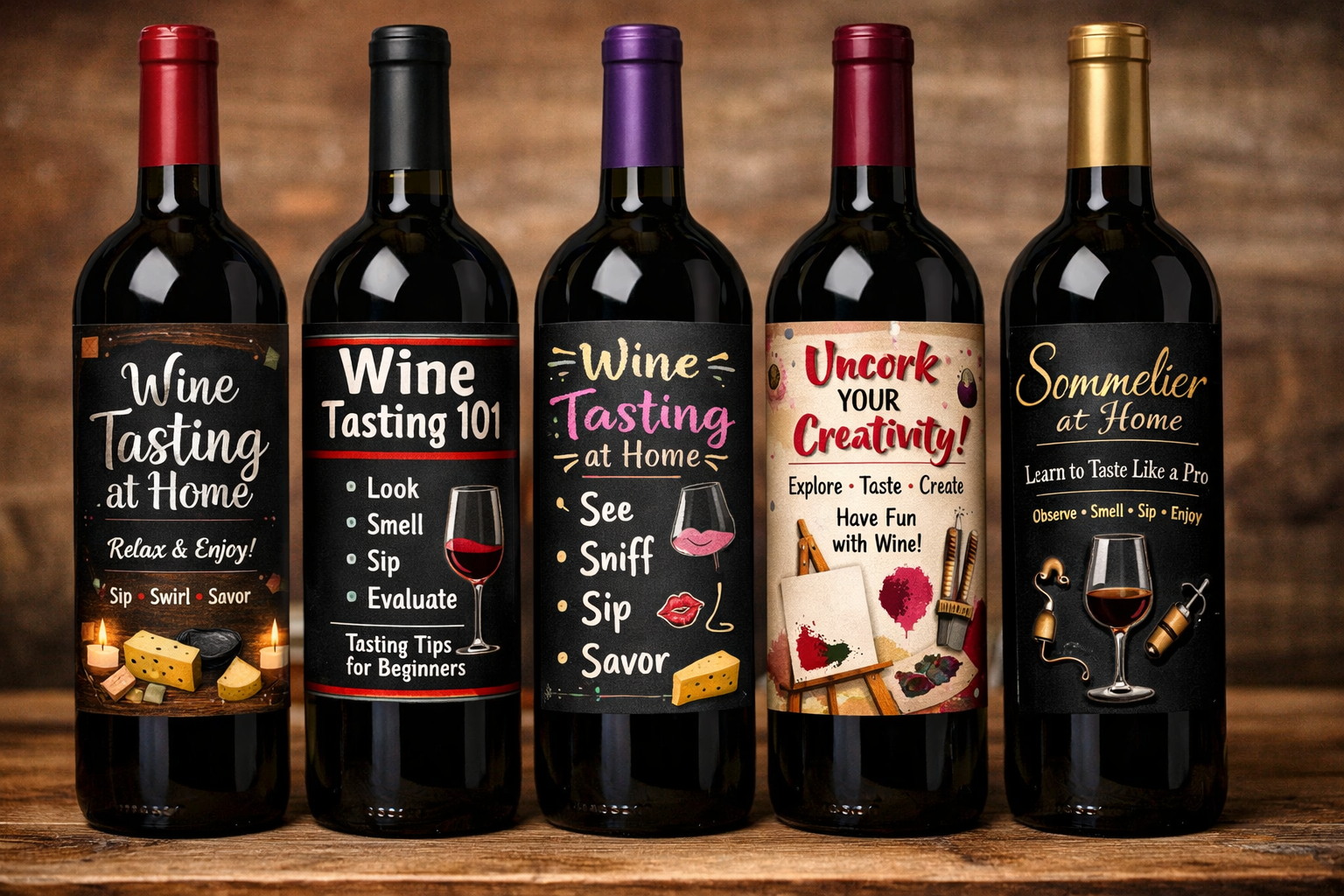
See: What color is it? Light, medium, dark? Any hints of gold, purple, ruby?Smell: Three words. Don't censor yourself. If it smells like your grandmother's garden, write that down.Taste: Is it sweet, dry, or somewhere between? Light-bodied or full? Does it make your mouth water (high acidity) or dry your mouth out (tannins)? Does the flavor disappear quickly or linger?Think: Did you like it? Would you order it again? What food came to mind?
That's four lines per wine. Fifteen minutes of notes for a full five-pour session. This kind of systematic approach builds reliable tasting skills over time.
Pacing Your Practice Session
Rush this and you'll miss everything. Space it out too much and you lose the comparison benefits.
Recommended pacing:
Spend 3–5 minutes on each pour
Take a sip of water and eat a plain cracker between wines
Return to earlier pours after you've tasted new ones (comparisons sharpen with repetition)
Total session time: 45–60 minutes for all five pours.
You don't need to finish every bottle. Pour 2–3 ounces of each, enough to smell and taste several times. Cork or cap the rest—most wines stay good for a few days with a stopper.
Some people spread the five pours across two sessions (three one night, two the next). That works fine, especially if you want to take your time. Just try to keep the comparison pours together—your baseline white and contrast white should happen in the same sitting.
A Low-Pressure Vocabulary List
Wine language intimidates people because it sounds like a performance. It doesn't have to be.
For describing what you smell:Fruity, floral, earthy, herby, spicy, oaky, toasty, buttery
For describing how it feels:
Light, medium, heavy (body)
Crisp, refreshing, mouth-watering (acidity)
Grippy, drying, chewy (tannins—that drying feeling like strong tea)
Smooth, silky, rich, thin (texture)
For describing what you think:
Balanced (everything works together)
One-note (not much complexity)
Interesting (something unexpected)
Easy-drinking (no effort required)
Food-friendly (wants something to eat with it)
For describing whether you like it:
"I'd order this again"
"Not for me"
"Perfect for a Tuesday night"
"Save this for a special occasion"
That last category matters most. Personal preference is the only metric that actually matters when you're buying wine for yourself. The goal of tasting practice isn't to like what experts like—it's to know what you like with enough specificity to find more of it.
Picking Your Five Bottles
Here's a shopping list that covers the five-pour sequence:
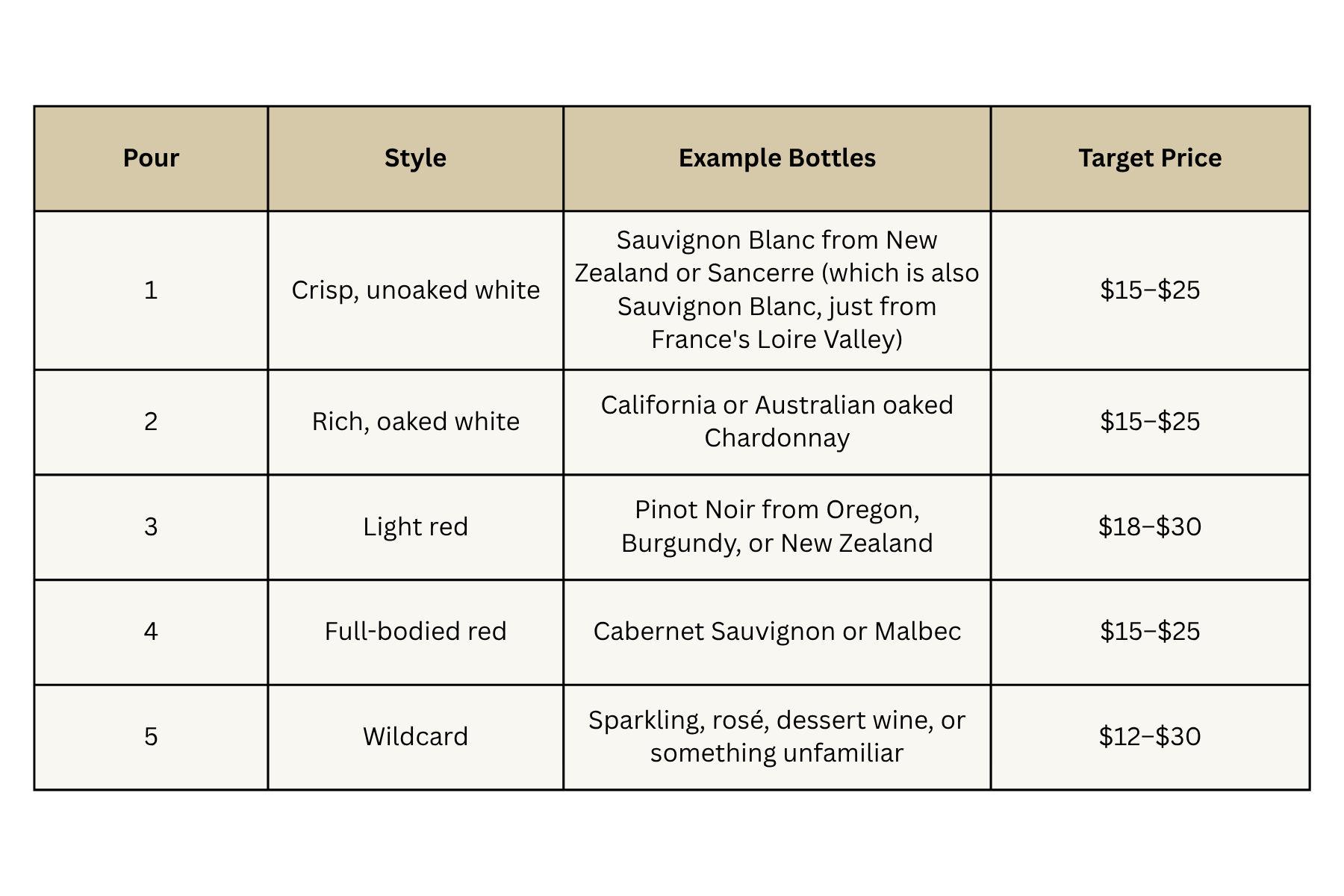
Budget note: You don't need expensive bottles for learning. Bottles in this $15–$25 range teach you just as much about structure and style as premium ones. Save the splurge for when you know what you're looking for.
Better approach: Ask someone who knows wine to help you pick bottles that clearly demonstrate these categories. A curated selection beats random grabbing from grocery shelves every time.
Common Beginner Mistakes (and How to Avoid Them)
Tasting too fast. Your first impression matters, but so does how the wine changes over ten minutes in the glass. Give it time.
Not writing anything down. Memory lies. You'll forget which one you liked by the time you're buying your next bottle. Even three-word notes help.
Comparing everything to "good" or "bad." Some wines aren't trying to do what other wines do. A light, crisp Pinot Grigio isn't worse than a big Cabernet—it's playing a different game. Judge wines against their category.
Overthinking it. Wine tasting is pattern recognition. The more you taste, the more patterns you notice. There's no test at the end. Just drink, pay attention, and write a few words.
What Happens After Your First Practice Session
You'll start noticing things you didn't before. A wine at dinner will remind you of your baseline Sauvignon Blanc—or feel completely different. You'll start using words like "acidic" or "tannic" and actually mean something specific.
More importantly, you'll know what to ask for. "I liked that oaky Chardonnay but not the crisp one" is enough information for any good wine shop to point you toward your next bottle.
This is how expertise builds—not through memorizing regions or vintages, but through accumulating reference points. Your five pours become the foundation for every wine you taste afterward.
Come Hang Out and Keep Learning
Home practice teaches you fundamentals. But there's something about tasting with someone knowledgeable—having your observations confirmed, getting pointed toward what you might notice next—that accelerates learning.
If you're near Downtown Dixon and want help picking bottles for your next home tasting, swing by The Pip Wine Bar & Shop. We stock hand-selected bottles you won't find in grocery stores, and we love helping people figure out what they actually like. Not sure where to start? Just tell us what you usually drink. We'll guide you from there.
Come hang out. Ask what you should try first. That's what we're here for.
Frequently Asked Questions
How many bottles do I need to start tasting wine at home?
Five bottles covering different styles gives you the comparison range needed to start building your palate. You don't need to finish them all in one session—pour small amounts (2–3 ounces each), taste deliberately, and save the rest for the next few days. Most wines keep well with a simple stopper.
Do I need special wine glasses for home tasting practice?
Standard clear wine glasses with a tulip shape work fine. The shape helps concentrate aromas at the opening, making it easier to smell what's in the glass. You don't need crystal or varietal-specific stems to learn effectively. Use what you have.
How long should I spend on each wine during a tasting?
Three to five minutes per pour is a good starting range. This gives you time to smell, taste, let the wine open up slightly, and jot down notes. Rushing produces less useful observations than taking your time with fewer wines.
What if I can't identify the flavors everyone else talks about?
Completely normal. Flavor vocabulary develops over time, and there's no "wrong" way to describe what you taste. If a wine reminds you of your backyard after rain, write that down. Your descriptions become more specific with practice—and your personal associations are just as valid as textbook descriptors.
Can I learn to taste wine without becoming a wine snob?
Absolutely. The goal is understanding your own preferences, not performing expertise. The best tasters stay curious and unpretentious—they know that personal enjoyment matters more than impressing anyone with vocabulary. If you like it, it's good wine. That's the whole point.
About The Pip Wine Bar & Shop
The Pip Wine Bar & Shop has been guiding wine enthusiasts through curated selections in Downtown Dixon. Our approach focuses on making good wine accessible—helping both beginners and experienced drinkers find bottles they'll genuinely enjoy. The team tastes extensively to stock a selection built on quality and discovery rather than mass-market availability. Whether you're building your home tasting skills or looking for your next favorite pour, we offer the kind of low-pressure guidance that turns curiosity into confident preferences. Not sure what you like? Tell us what you usually drink. We'll help you find what's next.