Wine Flight vs Glass vs Bottle: Which Order Makes Sense for Your Night?
You're at the wine bar, menu open, and there it is—the familiar question: flight, glass, or bottle?
The right answer has nothing to do with what sounds impressive. It depends on who you're with, what you're eating, how long you're staying, and whether you're in the mood to discover something new or stick with what you love.
At The Pip, we walk guests through this decision every night. Here's how we think about it.
The Three Formats, Explained
Wine flights are curated tastings—typically three to four smaller pours served together. They're built for comparison, letting you taste across styles, regions, or grape varieties side by side.
By-the-glass pours give you flexibility. You commit to one wine at a time, which works when you want variety without structure or when you're not sure how long you're staying.
Bottles are the classic sharing format. A standard 750ml bottle yields roughly five glasses, making it practical for groups or longer evenings when the table agrees on a style [1].
Each format serves a different purpose. The trick is knowing which one fits your actual plans.
Four Questions That Point You to the Right Order
Your mindset shapes your order more than anything else.
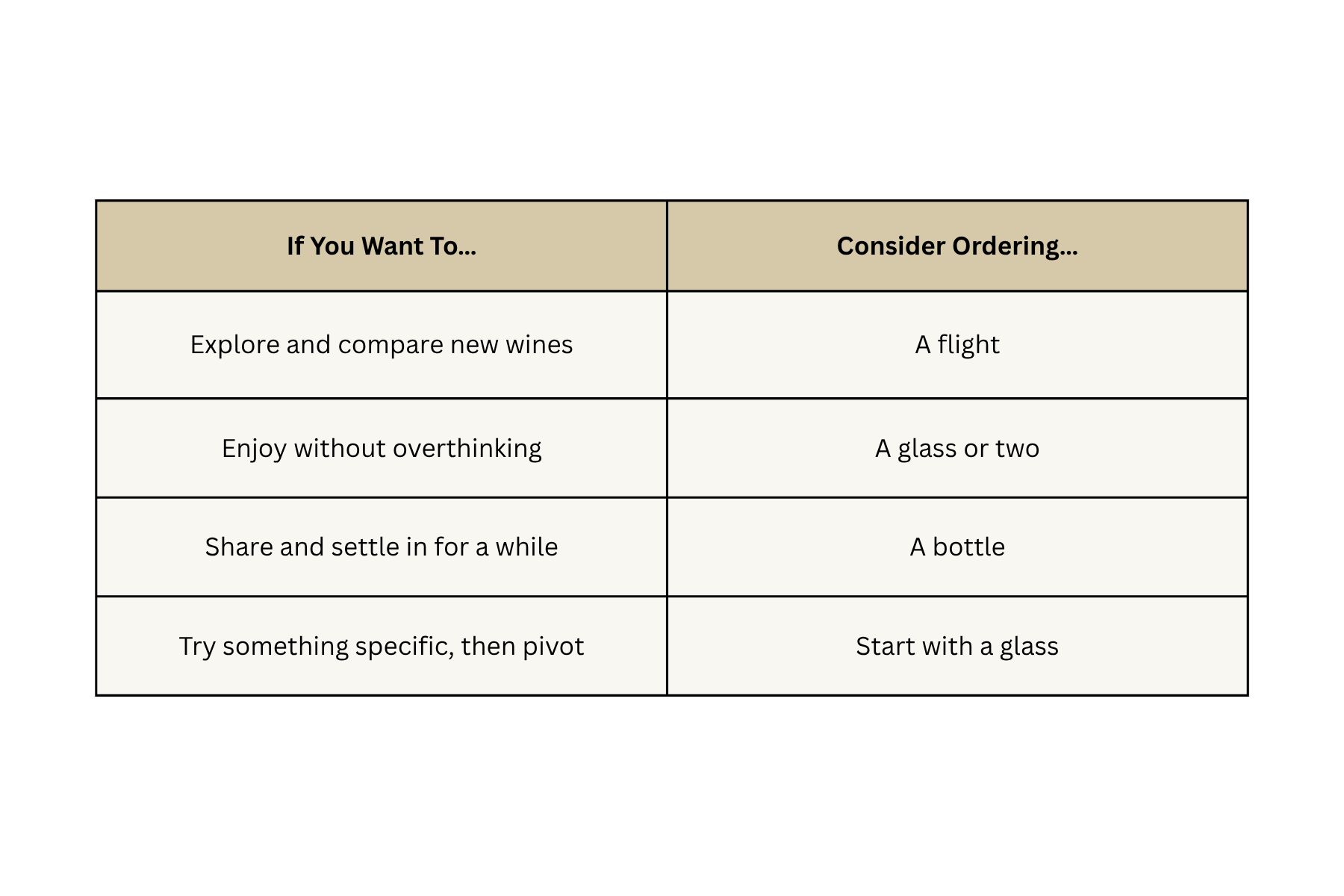
Feeling curious? Flights reward that energy. Tasting wines side by side sharpens your palate—you'll notice differences you'd miss drinking one wine in isolation [2]. You might discover you prefer Albariño's salinity over Pinot Grigio's crispness, or that bolder reds suit you more than you realized.
Just want to unwind? Skip the tasting exercise. A familiar glass or a bottle you've loved before keeps things simple.
2. How Many People Are You With?
Group size changes the math—both practically and financially.
Solo or a pair: Flights and glasses give you range without waste. A flight for one, followed by a full glass of your favorite from that tasting, creates a satisfying arc.
Groups of three or four: Bottles start making sense here. You'll typically get better per-glass value, and sharing a bottle creates a focal point for the table. That said, if everyone wants something different—one person craving a bold Malbec while another wants something crisp and light—individual glasses keep everyone happy [3].
Larger groups: Consider splitting—one bottle of red, one white, plus a flight for the adventurous person at the end of the table. Mixed orders work fine. We expect them.
3. Are You Eating?
Food changes your wine needs.
If you're ordering tapas-style bites—say, a cheese board with aged Manchego and some marcona almonds—glasses offer the flexibility to match different dishes as they arrive. Start with something crisp like a Verdejo that cuts through the richness, then shift to a medium-bodied red as heartier plates hit the table.
If you're settling into a longer meal with consistent flavors, a bottle can anchor the experience. Pairing works best when you can taste wine and food together repeatedly, not just once [4].
Flights pair naturally with shareable food boards. The variety in the flight mirrors the variety on the plate—you can experiment with what goes with what.
4. How Long Are You Staying?
Time matters more than most people realize.
Quick stop (under an hour): One or two glasses. Keep it simple.
Leisurely evening (two-plus hours): A bottle lets you pace yourselves without flagging down staff for refills. Or start with a flight to explore, then order a full glass of whatever you liked best.
Somewhere in between: Mix formats. A glass to start, assess your mood, then decide if you want another or if a bottle makes sense for the rest of the night.
Dixon sits at a natural halfway point between Sacramento and the Bay Area, between Napa and points east—which means plenty of our guests are meeting friends here and settling in for a few hours. If that's you, the pacing question matters.
The Price Question: When Does a Bottle Beat Multiple Glasses?
Here's the financial reality most people wonder about but rarely ask.
Wine bars typically price by-the-glass pours at roughly one-quarter to one-third the bottle price—meaning three to four glasses often equals or exceeds the cost of buying the whole bottle. The exact math varies by venue, but the general rule holds: if two or more people plan to drink three-plus glasses of the same wine, a bottle usually offers better value.
But value isn't just arithmetic. Bottles also let you experience how wine evolves in the glass over 30 or 40 minutes. Many wines open up after sitting, revealing characteristics you'd miss with a single pour [5]. And there's something to the ritual—pouring for each other, watching the level drop, sharing the experience.
When you're unsure, ask. A straightforward "Would a bottle make more sense for us?" gets you a direct answer from someone who does this math all day.
When Flights Make the Most Sense
Flights aren't just for beginners—though they're excellent for newcomers who want low-pressure exploration.
Order a flight when:
You're curious about a region, grape, or style you haven't tried
You want to compare similar wines (three different Chardonnays, for example)
You're trying to figure out what you actually like
You want a structured tasting experience rather than casual sipping
The wine bar offers a themed flight that sounds interesting
A well-constructed flight tells a story. Maybe it moves from light to bold, or across three countries growing the same grape. Pay attention to the order—there's usually a reason behind the sequence [6].
Take your time with flights. The point is noticing how each wine differs. Sip one, then the next, then back to the first. That comparison is where the learning happens.
When a Glass Is the Right Call
Glasses are the most flexible option, and flexibility has real value.
Order by the glass when:
You want to try something without committing to more
Your group can't agree on a single bottle
You're eating multiple small plates with different flavor profiles
You want to start light, then shift to something bolder
You're not sure how long you're staying
Glasses also work as a test drive. Curious about that orange wine or natural pour everyone's talking about? A single glass lets you try it without regret if it's not your thing.
When a Bottle Makes Sense
Bottles aren't just about volume. They create a different kind of experience.
Order a bottle when:
You're with two or more people who agree on a style
You're settling in for a longer evening
You've found a wine you love and want to enjoy it fully
You want to share the ritual of pouring for each other
The occasion calls for something celebratory
Don't order a bottle just because it feels like the "proper" thing to do. If you're solo or uncertain, glasses are perfectly fine.
Mixing Formats: The Underrated Strategy
You don't have to pick one format for the whole evening.
A pattern that works well:
Start with a flight to explore and calibrate your palate
Order a glass of whichever wine from the flight you liked best
If everyone at the table liked the same one, consider a bottle for round two
Another approach: one person orders a flight while the other orders a glass of something they already know they love. You both get what you want, and you can share tastes.
We appreciate guests who engage with the menu thoughtfully. Mixing formats shows you're there to enjoy the experience, not just check a box.
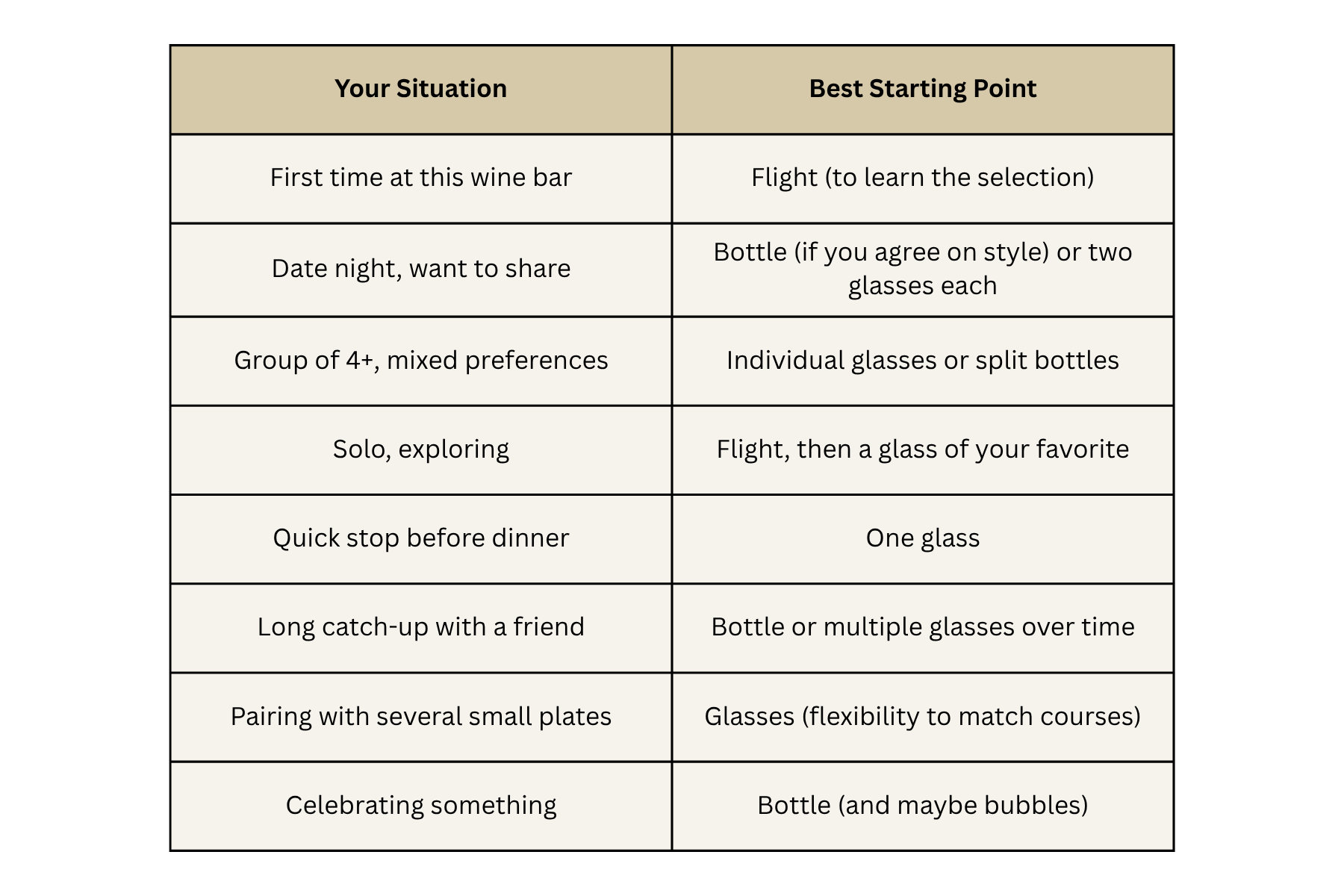
Quick-Reference Decision Table
When You're Still Not Sure, Ask
Seriously. A good wine bar team loves this question. They can tell you what's pouring well today, what's new, and what might suit your mood.
Try something like:
"I usually drink ___, but I want to try something different. What's in your current flight?"
"We're sharing small plates—what would you pour for the table?"
"I'm not sure if I want a glass or a bottle. What do you recommend for two people staying a couple hours?"
The staff sees every combination of group size, preference, and occasion. They'll point you toward what works.
Making the Most of Whatever You Order
A few habits that improve the experience regardless of format:
Take your time. Wine rewards patience. Let it sit in the glass for a moment. Notice how the first sip differs from the third.
Taste before you commit to more. If you order a glass and it's not quite right, you haven't lost much. Adjust on the next round.
Compare when you can. Even without a flight, taste what your friends are drinking. Side-by-side comparison is the fastest way to learn your own preferences.
Trust your palate, not the price. The most expensive option isn't automatically the best fit for your evening. Order what sounds good to you.
Ready to Put This Into Practice?
The best way to figure out what works for your nights out is to experiment. Try a flight next time you'd normally order a glass. Split a bottle with a friend when you'd usually order separately. Pay attention to what makes the evening better.
Check out the current menu at The Pip to see what's pouring today. Whether you're meeting friends halfway in Dixon, planning a date night, or looking for a comfortable place to unwind, the right format is the one that matches your evening—not someone else's idea of how wine should be enjoyed.
Come hang out. We'll help you figure out what to order.
Frequently Asked Questions
Is a wine flight just for beginners?
Not at all. Flights serve experienced wine drinkers who want to explore a new region, compare vintages, or taste across a theme. The side-by-side format sharpens your palate regardless of experience level. Many wine professionals use comparative tasting as their primary learning tool—it's how you notice subtleties that get lost when drinking one wine in isolation.
How do I know if a bottle is worth it versus ordering glasses?
If two or more people plan to drink three-plus glasses of the same wine, a bottle typically offers better value. But value isn't just math—bottles also let you experience how wine evolves over time in the glass and create a shared ritual for the table. When in doubt, ask your server to run the numbers.
Can I order a flight and a glass at the same time?
Absolutely. This is a popular approach for people who want to explore but also want a full pour of something familiar. Start with the flight to discover options, then follow up with a glass of your favorite. Wine bars expect and welcome mixed orders.
What if I order a glass and don't like it?
Mention it to your server. Most wine bars want you to enjoy what you're drinking. They may offer suggestions for your next glass or help you understand what didn't work so you can choose better next time. One less-than-perfect glass isn't a ruined evening—it's useful information.
Should I order wine before or after I see the food menu?
Looking at both together helps. If you're planning to share several small plates, you might want flexible by-the-glass pours that can shift as new dishes arrive. If the food is straightforward, a bottle might anchor the meal nicely. When in doubt, ask staff for pairing suggestions—they see the combinations that work best every night.
About The Pip Wine Bar & Shop
The Pip is a woman-owned wine bar and bottle shop in Downtown Dixon, California—a comfortable spot for adults who appreciate curated wine, craft cocktails, and wine slushies without pretense. The team hand-selects bottles from small producers you won't find in grocery stores, and they're happy to guide you toward something you'll love whether you're a first-timer or a seasoned enthusiast. Dixon sits at a natural halfway point between Sacramento and the Bay Area, between Napa and points east, making The Pip an ideal destination when you want to meet friends somewhere comfortable and actually enjoy hanging out for a few hours.
Cited Works
[1] Wine Folly — "How Many Glasses in a Bottle of Wine?" https://winefolly.com/tips/how-many-glasses-in-a-bottle-of-wine/
[2] Guild of Sommeliers Education Foundation — "Comparative Tasting Methods." https://www.guildsomm.com/tc/study/w/wiki/comparative-tasting
[3] VinePair — "The Etiquette of Ordering Wine at a Restaurant." https://vinepair.com/articles/etiquette-ordering-wine-restaurant/
[4] Wine Spectator — "The Basics of Pairing Wine and Food." https://www.winespectator.com/articles/the-basics-of-pairing-wine-and-food
[5] Wine Enthusiast — "Does Wine Really Need to Breathe?" https://www.winemag.com/2019/05/20/does-wine-need-to-breathe/
[6] Decanter — "How to Taste Wine: A Beginner's Guide." https://www.decanter.com/learn/how-to-taste-wine-beginners-guide-377498/